The Socratic Algorithm
How Project Synapse is Architecting a National Human Resource Engine, One Classroom at a Time
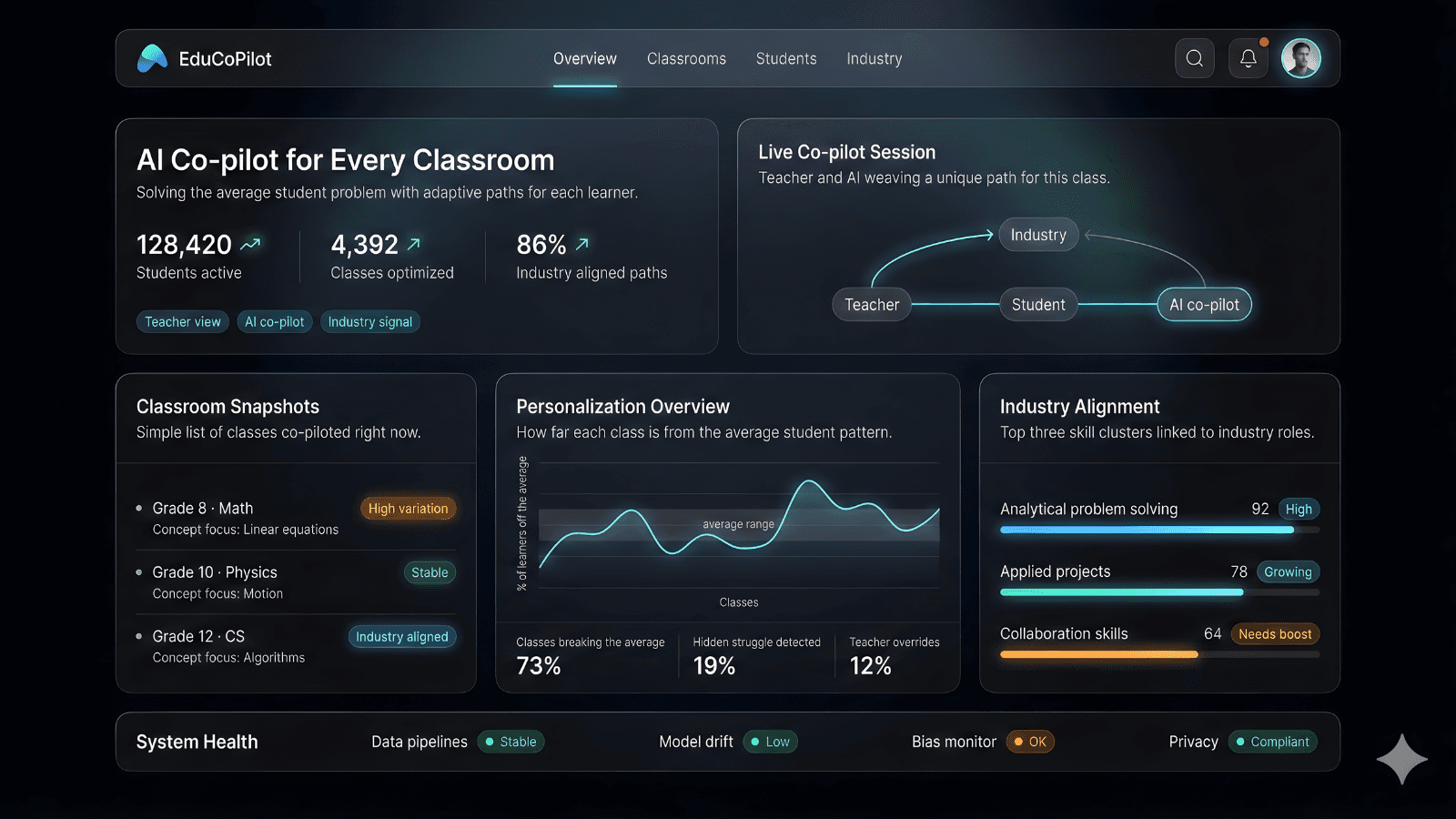
Executive Summary
The foundational flaw of modern education is its design principle: teaching to the average. This industrial-era model creates a permanent state of compromise that, at a national scale, results in a systemic disconnect between education and industry—a crisis of human potential. Project Synapse addresses this by re-architecting the classroom dynamic itself. It is an AI-powered co-pilot for teachers, built around a Deep Reinforcement Learning (DRL) agent that models a real-time 'Learner State Vector' for each student. By moving beyond simple content recommendation into true cognitive orchestration, Synapse creates a symbiotic teacher-AI relationship that makes personalized mastery at scale a reality, aiming to transform the educational pipeline into a real-time, adaptive engine for national development.
The Classroom Compromise and its National Cost
The bell curve is a useful statistical tool, but it has become a destructive model for education. Our system is built to serve a hypothetical 'average' student who doesn't exist, forcing diverse minds like Rohan (struggling) and Priya (advanced) through the same process. This classroom-level compromise, when scaled across a nation, creates a jarring paradox: millions of graduates, yet a chronic shortage of employable talent.
The Data of Disconnection
Our research confirmed this model is failing at every level:
The Ed-Tech Illusion: Why 'Personalization' Wasn't Personal
Before architecting Synapse, we had to diagnose why the first wave of ed-tech failed to make a real impact. The answer was a fundamental misunderstanding of the problem. They treated education as a content delivery problem, not a cognitive development problem. Their 'personalization' was just a glorified playlist, blind to the most critical variable: the student's internal state. Is Rohan confused, or just unconfident? Is Priya bored, or synthesizing material in a new way? Without this insight, you're just throwing videos at a wall and hoping something sticks.
The Architectural Flaws of a Digital Textbook
First-generation platforms were built on a flawed foundation:
1. Cognitive Blindness: They could track clicks and video completions, but had zero insight into a student's confidence, frustration, or the structure of their knowledge graph.
2. The Teacher Silo: These tools often burdened teachers, forcing them to manually analyze dashboards of meaningless engagement data. They added to the noise instead of providing a clear signal.
3. Optimizing for Clicks, Not Mastery: Their algorithms were designed to maximize short-term engagement, not long-term understanding. This led to a system that was easy to 'game' but poor at teaching.
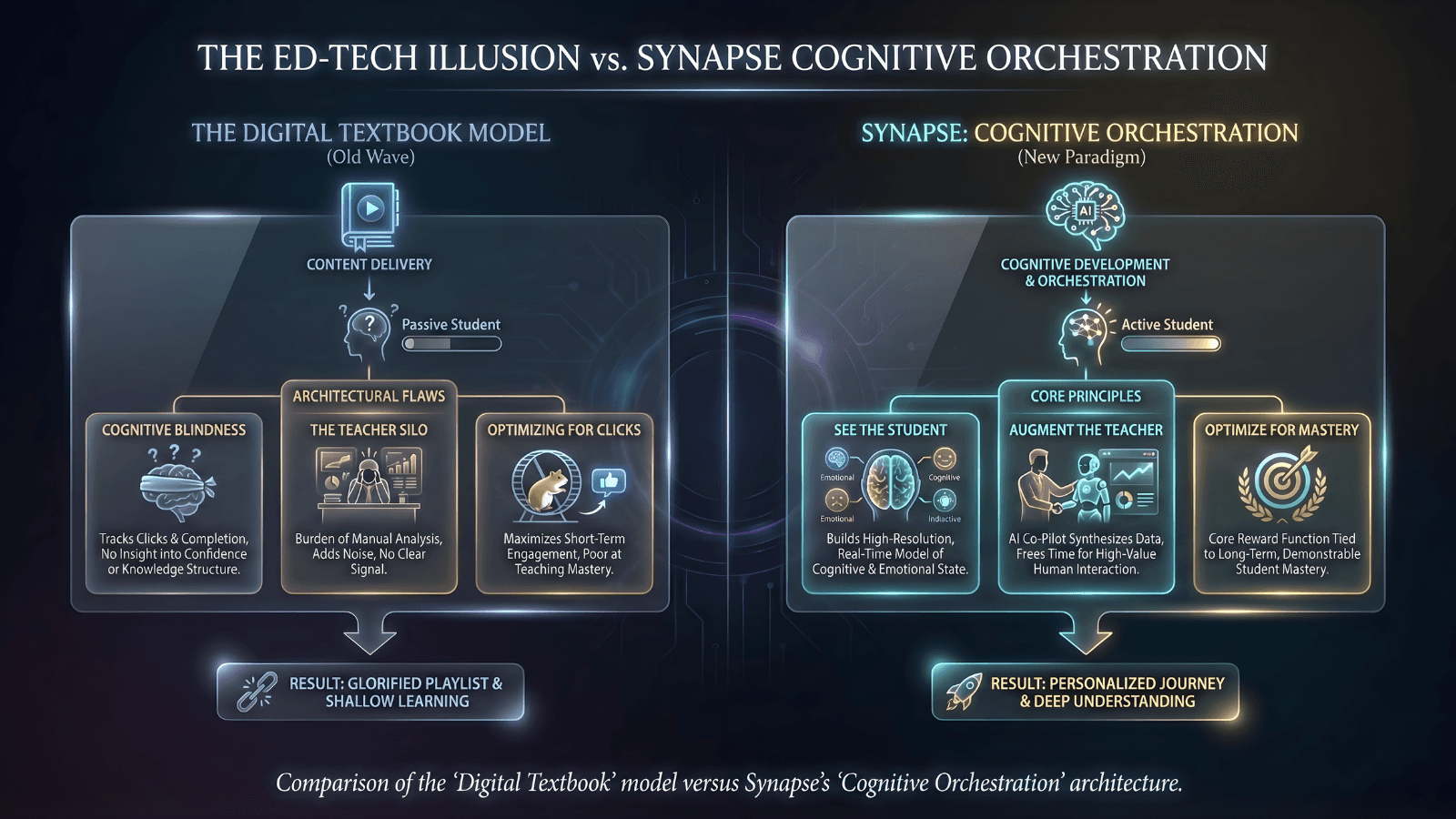
Comparison of the 'Digital Textbook' model versus Synapse's 'Cognitive Orchestration' architecture.
Our Core Principles: From Content Delivery to Cognitive Orchestration
This failure led us to the three core design principles of Synapse:
- Principle 1: See the Student. The system's primary job is to build a high-resolution, real-time model of each student's cognitive and emotional state.
- Principle 2: Augment, Don't Automate, the Teacher. The AI's role is to be a co-pilot, handling the data synthesis to free up the teacher's time for high-value human interaction.
- Principle 3: Optimize for Mastery. The system's core reward function must be tied to long-term, demonstrable student mastery, not superficial engagement metrics.
The Synapse Architecture: Engineering a Socratic Co-Pilot
We didn't just build a better playlist; we architected a system that could reason about teaching itself. We built a co-pilot that could work symbiotically with a human teacher to guide each student's unique journey.
Technical Solution 1: The Dyad-RL Cognitive Core
Problem: How do you move beyond right/wrong testing to understand a student's true knowledge graph?
Solution: The core of Synapse is a Deep Reinforcement Learning agent based on the Dyad-RL psychometric framework. It pairs an 'Assessor' agent that probes knowledge with a 'Profiler' agent that constantly updates a rich Learner State Vector (knowledge, confidence, frustration). Its 'actions' are pedagogical moves: `generate_analogy_for_rohan`, `create_synthesis_challenge_for_priya`, `suggest_teacher_intervention`.
Justification: This architecture allows the AI to think like a master strategist. It optimizes for long-term mastery, not just clicks, building a high-resolution map of each student's mind.
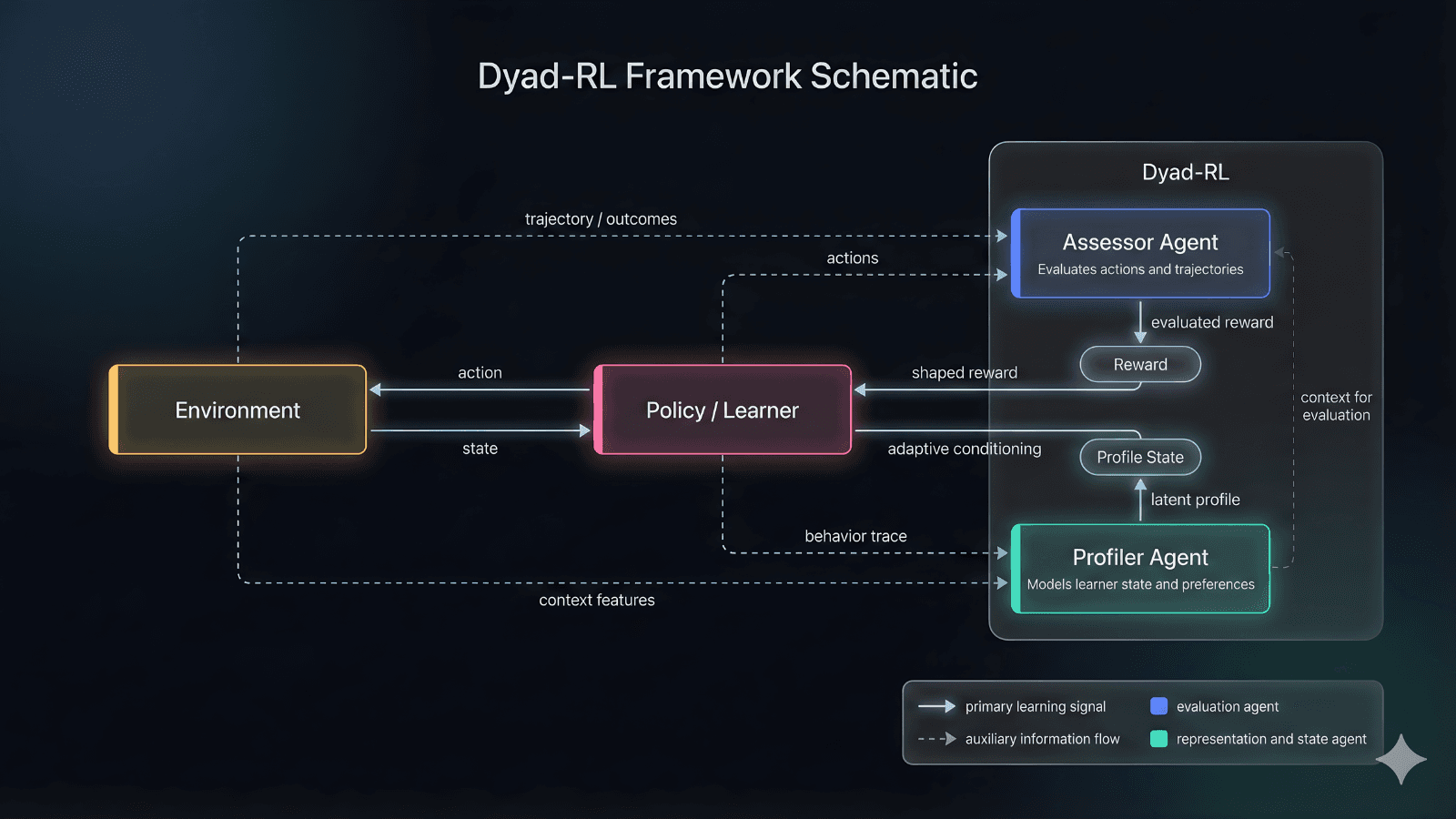
Schematic of the Dyad-RL framework, showing the interaction between the Assessor and Profiler agents.
Technical Solution 2: The Augmented Teacher Interface
Problem: How do you empower a teacher without overwhelming them with data?
Solution: Synapse provides a clean, diagnostic co-pilot, not a surveillance tool. It uses proactive alerts to flag when a student is stuck or when they are ready for a new challenge, which the AI can instantly generate.
Justification: This augments the teacher's greatest strength: their human intuition. The AI handles the data-synthesis, freeing up Ms. Devi to connect, mentor, and inspire.
Technical Solution 3: The MLOps Feedback Loop for a Living Curriculum
Problem: A static curriculum is obsolete the moment it's published. How do you create a curriculum that evolves with industry needs?
Solution: Synapse's curriculum is a dynamic entity powered by an MLOps workflow. Aggregated, anonymized student data continuously retrains baseline models, while industry partners can feed real-time skill requirements into the system, directly influencing learning paths.
Justification: This creates a live feedback loop between academia and industry. The platform learns what the market needs and adapts, ensuring the curriculum is never out of date and students are always learning relevant skills.
Impact: From Classroom Dynamic to National Potential
Our pilot program confirmed that this symbiotic teacher-AI relationship changes everything. The results show a dramatic impact at the classroom level, with a clear trajectory toward a national-scale revolution in human resource development.
Architectural & Impact Comparison
The difference between the old paradigm and Synapse is stark.
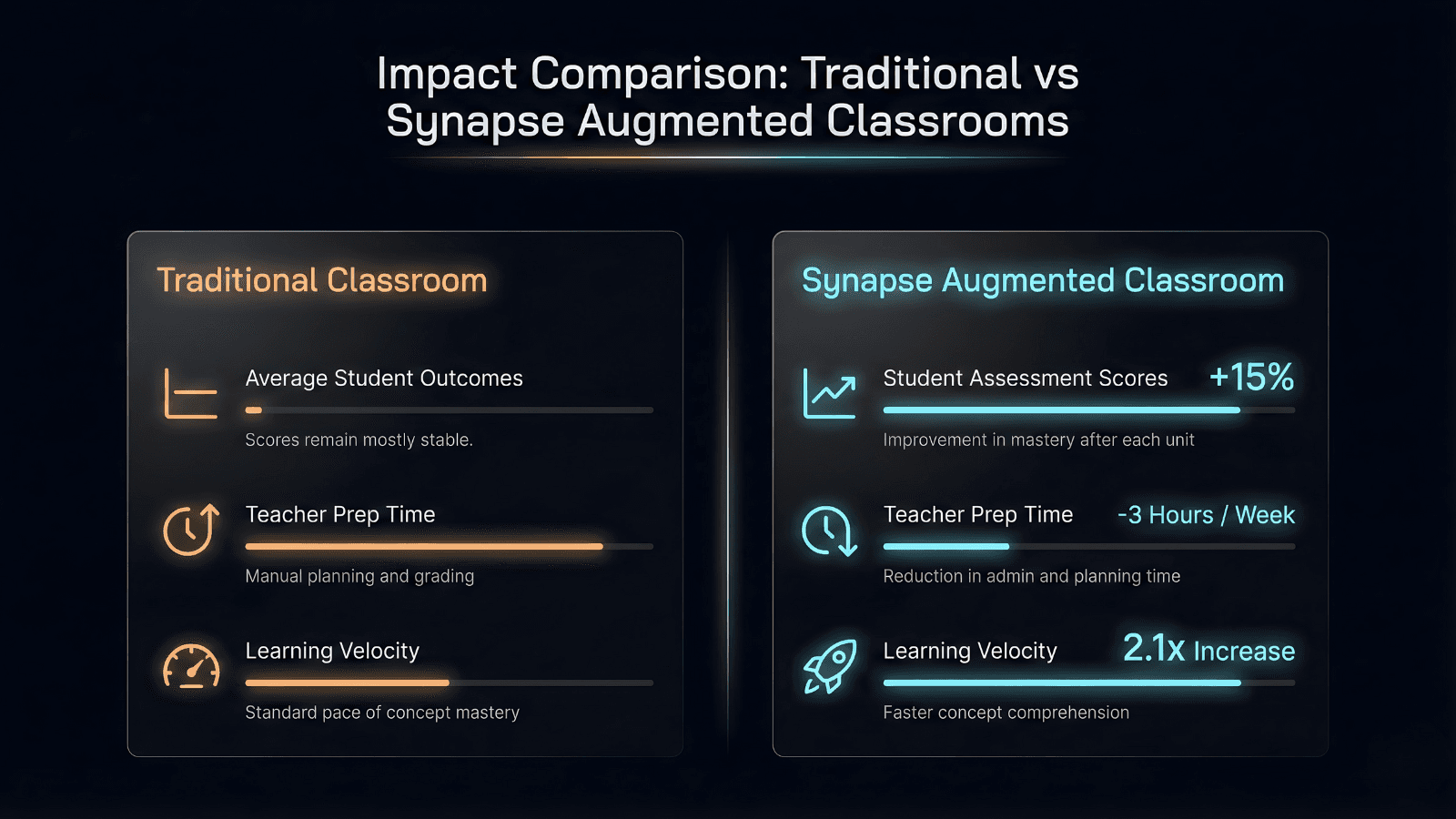
A side-by-side comparison of key metrics between traditional classroom models and Synapse-augmented classrooms.
Pilot Program v0.1 & Projected National Impact
We deployed Synapse v0.1 in 50 diverse classrooms, from elite urban centers to under-resourced rural schools. The fear was that AI would distance the teacher from the student. The reality was the opposite. By offloading the 'cognitive grunt work' of grading and pattern recognition, teachers reported having 3x more face-to-face mentorship time with struggling students. The 'average student' vanished. In their place, we saw individual learning velocities diverge and accelerate, with the bottom quartile of students showing the most dramatic gains, effectively closing the achievement gap in real-time.
Conclusion: A Human Resource API for a Nation
Project Synapse is built on a simple, radical belief: the 'average student' is a fiction, and it's time we stopped designing our schools for them. By creating a true cognitive co-pilot, we empower teachers to become mentors and architects of learning. The ultimate vision extends beyond the classroom. By creating a real-time, queryable map of our nation's evolving skills, we are building a foundational API for human potential. A future where industries can signal their needs and have the education system respond in months, not decades. The future of education isn't about choosing between technology and the teacher. It's about creating a perfect synapse between the two.